
Healthcare teams invest heavily in CRM systems, automation tools, and digital engagement platforms, yet many still struggle to improve the actual patient experience. The reason is rarely the technology itself. It’s the lack of clarity around what should be measured and why those measurements matter across the full patient journey, especially when CRMs are expected to support more advanced use cases like segmentation and personalized patient journeys (as explored in this guide on Dynamics 365 CRM segmentation for patient journeys.
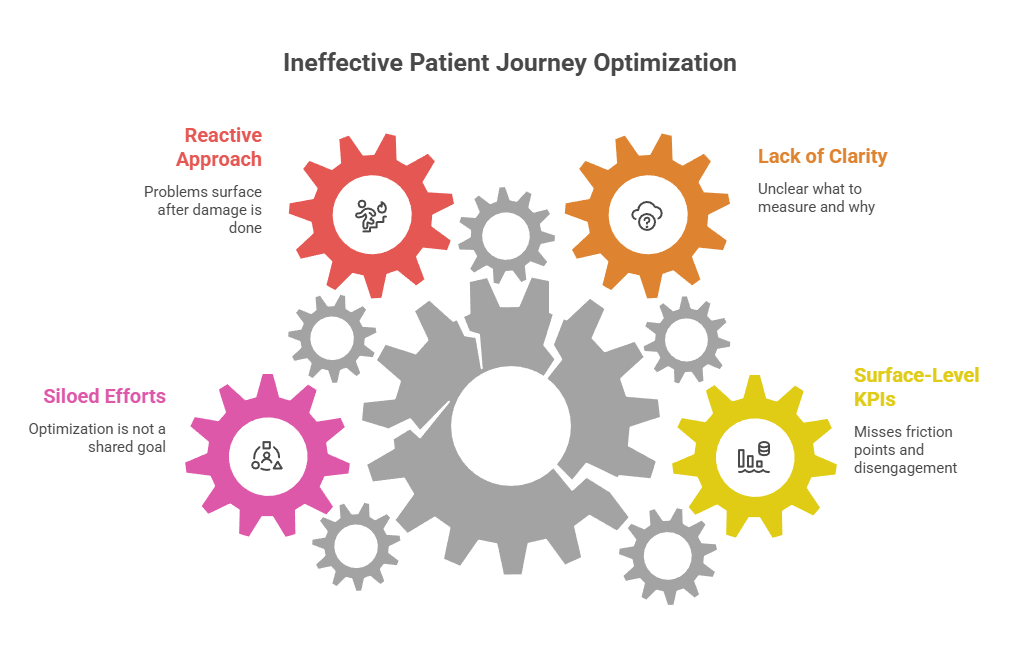
Most organizations track surface-level KPIs like appointment volume or satisfaction scores, but these metrics don’t reveal where patients feel friction, disengage, or fall through the cracks. Without the right journey-level metrics, delays, missed follow-ups, and communication breakdowns remain invisible until outcomes suffer.
Optimizing the patient journey requires a different mindset. It means tracking how patients move from first contact to ongoing care, how they respond at each step, and where momentum is lost. When healthcare teams measure the right things, CRM data becomes actionable, automation becomes meaningful, and patient experience improves without adding operational strain.
This article explains which metrics truly matter and how to use them to optimize the patient journey in a practical, measurable way.
Healthcare teams should track patient journey metrics that measure access, engagement, appointment attendance, follow-up completion, patient experience, operational efficiency, and compliance. These metrics reveal where patients face delays, disengage, or drop off, allowing teams to optimize workflows, improve communication, and deliver more consistent, patient-centered care.
Why Metrics Are the Foundation of Patient Journey Optimization
Optimizing the patient journey is not about adding more automation or technology. It starts with understanding how patients actually move through the system. Metrics provide that visibility.
Without journey-specific metrics, healthcare teams operate reactively. Problems surface only after patients miss appointments, disengage from care, or submit complaints. By then, the damage is already done.
Journey metrics shift the focus from isolated events to patterns. They show where momentum slows, where communication fails, and where patients silently exit the system. This insight allows teams to intervene earlier, refine automation logic, and prioritize improvements that matter most to patients.
Metrics also create alignment. When clinical, operational, and administrative teams measure the same journey indicators, optimization becomes a shared goal rather than a siloed effort.
Access and Intake Metrics That Shape First Impressions
The patient journey starts well before a patient ever walks through the door. First impressions are formed during access and intake, when patients are trying to book appointments, follow referrals, or simply understand what happens next. This early phase sets the emotional tone for the entire experience.
When wait times stretch too long, referrals stall, or booking feels confusing, trust erodes quickly. Patients may not complain, but many quietly disengage or look elsewhere. Research has shown that access delays are one of the strongest predictors of patient dissatisfaction and care abandonment, especially in outpatient settings (as highlighted by the U.S. Office of the National Coordinator for Health IT.
Access and intake metrics bring clarity to this blind spot. Measuring how long it takes for a patient to move from referral or inquiry to their first appointment reveals hidden delays in scheduling and coordination. Tracking referral-to-appointment conversion rates shows whether patients are falling out of the journey before care even begins. Monitoring booking abandonment highlights friction in portals, call flows, or digital forms, while channel performance data reveals where patients struggle or succeed when trying to access care.
When these metrics are visible, healthcare teams can act early. CRM systems can flag stalled referrals, surface scheduling bottlenecks, and guide patients toward faster, more reliable access channels. Instead of reacting to missed appointments later, teams can fix the problems that cause frustration at the very start of the journey.
Engagement and Communication Metrics That Predict Drop-Off
Patients rarely disengage all at once. In most cases, disengagement begins quietly, with a missed message, an ignored reminder, or a delayed response that never recovers. By the time a patient misses an appointment or drops out of care, the warning signs have usually been present for weeks.
Engagement and communication metrics help healthcare teams spot these early signals. They show whether patients are actually reading messages, responding to outreach, and staying connected between visits. High appointment volume can create the illusion of success, but if communication breaks down between interactions, the journey is already at risk. Studies have consistently shown that poor communication is a leading driver of patient disengagement and missed care opportunities (as outlined by the Agency for Healthcare Research and Quality.
Tracking how often patients open and respond to messages reveals which channels are working and which are being ignored. Reminder effectiveness highlights whether appointment and follow-up nudges are helping or simply adding noise. Patient portal adoption and usage patterns show whether digital tools are supporting engagement or creating friction. Two-way communication metrics, in particular, indicate whether patients feel invited into the conversation rather than talked at.
When engagement starts to decline, CRM systems make it possible to adjust in real time. Messaging cadence, channel selection, and timing can be refined based on actual patient behavior, replacing assumptions with evidence and helping teams intervene before disengagement becomes irreversible.
Appointment and Visit Metrics That Impact Outcomes and Revenue
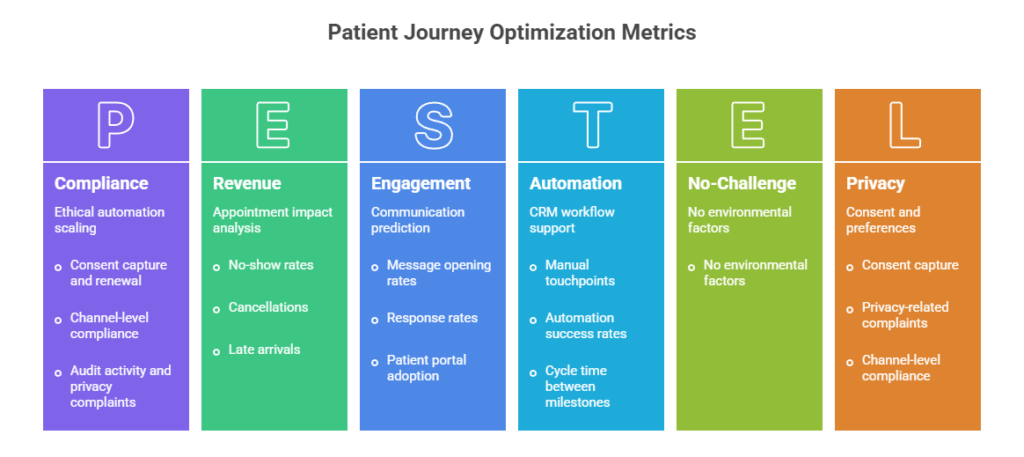
Appointments are one of the easiest parts of the patient journey to measure, yet they’re often analyzed in isolation. No-show rates, cancellations, and late arrivals are treated as operational problems rather than symptoms of earlier journey breakdowns.
A missed appointment is rarely the root issue. It’s usually the result of unclear communication, scheduling friction, or unmet expectations earlier in the journey. Without context, teams end up reacting to missed visits instead of preventing them.
By tracking no-show trends alongside cancellation and rescheduling behavior, healthcare teams can identify patterns that repeat across patient groups, appointment types, or communication strategies. Late arrival frequency adds another layer of insight, often pointing to logistical or timing challenges rather than lack of intent. Visit completion rates help confirm whether patients are making it through scheduled care as planned.
When these metrics are viewed over time, clear signals emerge. Certain reminders reduce no-shows, specific appointment types need different preparation, and some patient segments require more proactive support. This insight enables proactive intervention, shifting teams from reactive rescheduling to intentional journey optimization.
Care Continuity and Follow-Up Metrics Most Teams Miss
The most fragile part of the patient journey often begins after the visit ends. Patients leave with instructions, follow-up plans, and next steps, but many never complete them. These breakdowns rarely surface in satisfaction surveys, yet they directly affect outcomes and long-term engagement.
Care continuity metrics bring visibility to this critical gap. Measuring follow-up completion rates shows whether patients are continuing their care or silently disengaging. Tracking time to follow-up reveals delays that can weaken outcomes or erode trust. Care plan adherence indicators highlight whether instructions are realistic, understood, and supported. Drop-off rates between visits expose where momentum is lost.
When these metrics are monitored, the patient journey no longer ends at the appointment. CRM systems can automatically remind patients, escalate missed follow-ups, and alert care teams when intervention is needed. This approach supports continuity without placing additional strain on already busy staff.
Patient Experience and Outcome Metrics That Reflect Real Impact
Patient experience cannot be captured in a single moment. A post-visit survey may reflect how a patient felt that day, but it doesn’t tell the full story of their journey. Experience is shaped by trust, clarity, and consistency across every interaction, all of which are easy to overlook when measurement is too narrow.
Experience metrics are most meaningful when paired with behavioral data. A patient may report satisfaction after a visit yet fail to return for follow-up care, indicating a disconnect between perception and action. This gap is often influenced by factors like communication quality, consent handling, and compliance practices—areas where CRM design choices can directly affect patient confidence, as discussed in this overview on choosing a CRM for doctors and avoiding compliance risks.
Patient satisfaction scores, such as CSAT or NPS, provide directional insight into how care is perceived. Patient-reported outcome measures add depth by capturing how patients feel over time, not just immediately after a visit. Complaint and escalation patterns reveal friction points that surveys often miss. Retention and repeat visit rates show whether patients choose to continue their care journey.
Together, these metrics connect operational performance to real-world patient outcomes, creating a more complete and honest picture of care quality.
Operational and Automation Metrics Inside the CRM
Automation only adds value when it reduces friction for both patients and staff. Without measurement, automation can quietly create complexity instead of efficiency.
Operational metrics help teams understand whether CRM workflows are truly supporting the patient journey. Tracking manual touchpoints per patient reveals how much staff effort is still required despite automation. Measuring automation success versus override rates shows whether workflows align with real-world needs. Staff time saved per journey stage demonstrates operational impact, while cycle time between milestones highlights delays that automation should address. Research from McKinsey has shown that poorly designed automation often increases operational burden instead of reducing it, especially in complex environments like healthcare.
When automation is frequently bypassed or overridden, it’s a signal that workflows need refinement. Expanding automation without fixing these issues only amplifies the problem.
Compliance and Trust Metrics in Automated Journeys
In healthcare, trust is not optional. Automation that ignores consent, preferences, or privacy undermines patient confidence and exposes organizations to risk.
Compliance and trust metrics ensure that efficiency never comes at the expense of ethical care. Tracking consent capture and renewal rates confirms that patient permissions are current and respected. Channel-level compliance ensures patients are contacted only through approved methods. Audit activity and privacy-related complaints provide early warning signs when trust is at risk.
By monitoring these metrics, healthcare teams can scale automation responsibly, maintaining patient confidence while improving operational performance.
Common Mistakes Healthcare Teams Make When Tracking Patient Journey Metrics
One of the most common mistakes is tracking too many metrics without a clear purpose. Dashboards become crowded, patterns disappear, and teams struggle to act on the data.
Another frequent issue is focusing on isolated events instead of transitions. Drop-off doesn’t happen during an appointment or a message; it happens between steps. Without measuring those transitions, teams miss the most important signals.
Finally, many organizations measure diligently but fail to respond. Metrics only create value when they lead to workflow changes, automation adjustments, and better decision-making. Without action, measurement becomes a reporting exercise rather than a driver of improvement.
Conclusion
Optimizing the patient journey is not about collecting more data or adding more tools. It’s about understanding how patients actually move through care and responding to the moments where friction, confusion, or disengagement occur. When healthcare teams track the right metrics, patterns become visible that were previously hidden between systems and departments.
These insights change how CRM systems are used. Instead of serving as passive repositories of interactions, they become active engines for improvement. Teams can anticipate drop-offs, refine communication, and support continuity of care without increasing operational burden. Patients experience fewer delays, clearer next steps, and a sense that the system is working with them rather than around them.
The patient journey improves not because teams work harder, but because they measure what truly matters and act on it consistently. Metrics create alignment, automation gains purpose, and care becomes more connected across every stage of the journey.
If you’re evaluating how your CRM supports patient journey metrics or planning improvements, our CRM team offers a free consultation to help you identify gaps and practical next steps.
Frequently Asked Questions
What are patient journey metrics in healthcare?
Patient journey metrics measure how patients move through care, including access, engagement, appointments, follow-ups, and long-term retention.
Why are patient journey metrics important for healthcare teams?
They help teams identify delays, drop-offs, and communication gaps that negatively impact patient experience and outcomes.
How do patient journey metrics improve patient experience?
By revealing friction points early, teams can adjust workflows, communication, and follow-ups before patients disengage.
Can a CRM track patient journey metrics effectively?
Yes. A healthcare CRM can track interactions, timelines, engagement data, and automation outcomes across the full patient journey.
Which patient journey metric is most often overlooked?
Follow-up completion rate is frequently overlooked, yet it strongly influences care continuity and long-term outcomes.

