
In today’s fast-moving business landscape, agility isn’t optional it’s the foundation of growth. That’s why more organizations are leaning on Microsoft Dynamics 365, a platform designed with modular flexibility so you can scale operations without the burden of unnecessary complexity.
But here’s the real advantage: you don’t need every module. Instead, success comes from choosing the right combination of Dynamics 365 modules that align with your strategy whether that’s streamlining finance, modernizing supply chains, or creating a unified customer experience.
In this complete breakdown, we’ll explore nine Dynamics 365 modules that consistently help organizations unlock efficiency, boost revenue, and deliver world-class customer engagement.
And if you’re considering where to start, or how to customize these modules to fit your unique processes, that’s exactly where Skywinds CRM’s Dynamic 365 module Customization comes in. Our team specializes in tailoring Dynamics 365 to maximize ROI from configuration to advanced module customization ensuring your system works the way your business does.
Let’s dive into the modules that can accelerate your growth.
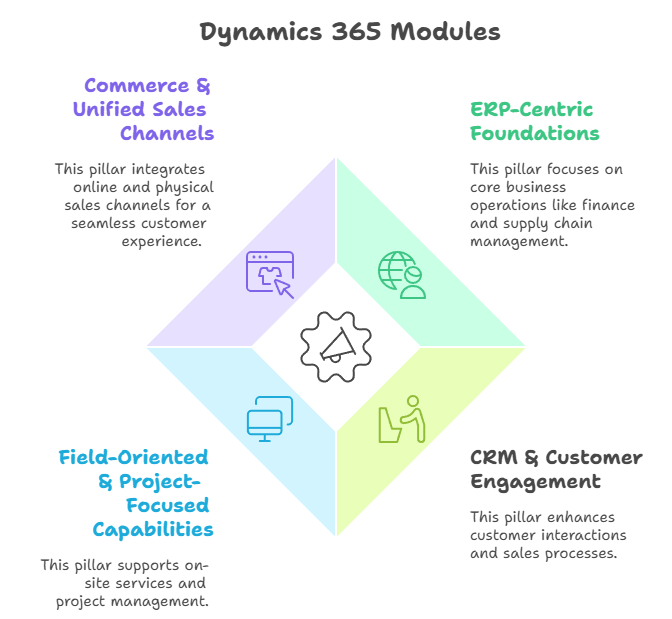
Section 1: ERP-Centric Foundations
ERP stands for Enterprise Resource Planning.
In the context of Dynamics 365, ERP modules are the ones that manage core business operations such as:
- Finance → Accounting, budgeting, compliance
- Supply Chain → Inventory, logistics, production
- Business Central → A lighter all-in-one ERP for small and mid-sized businesses
1. Dynamics 365 Business Central
For small and mid-sized organizations, Business Central serves as an all-in-one ERP solution that simplifies financial management, operations, sales, and supply chain activities. Unlike traditional ERP systems that feel heavy and inflexible, Business Central is built to scale with you.
Key capabilities include:
- Real-time visibility into cash flow and financial performance
- Automated supply chain workflows that reduce errors and delays
- Seamless integration with Microsoft 365 tools like Outlook, Teams, and Excel
- AI-powered forecasting to anticipate inventory needs
The result? Organizations operate with agility, making faster, data-driven decisions while minimizing costs. Business Central is particularly valuable for companies growing across multiple regions, where efficiency and compliance are non-negotiable.
2. Dynamics 365 Finance
When it comes to handling complex financial environments, Dynamics 365 Finance provides the advanced capabilities global organizations demand. From multi-currency and multi-language support to real-time financial reporting, this module delivers the insights finance leaders need to stay ahead.
Core benefits include:
- Automated accounts payable and receivable to cut down manual work
- Embedded analytics with Power BI for predictive insights
- Global tax and regulatory compliance tools
- Budgeting and forecasting to align financial planning with business goals
Finance leaders in cross-border operations gain a centralized system that not only reduces reporting cycles but also improves compliance with regional standards in markets like North America and Europe.
3. Dynamics 365 Supply Chain Management
A resilient supply chain is no longer optional it’s a competitive differentiator. With Supply Chain Management, companies can optimize their entire logistics network, from procurement to warehouse to final delivery.
Capabilities include:
- Real-time inventory tracking across multiple locations
- Advanced production planning and scheduling
- AI-driven demand forecasting to prevent stockouts or overstocking
- Streamlined warehouse automation for faster fulfillment
This module empowers businesses to stay agile even during disruptions, ensuring customer expectations are met consistently. For manufacturers, distributors, and retailers, it’s the backbone of operational excellence.
Section 2: CRM & Customer Engagement
4. Dynamics 365 Sales
Every business depends on a healthy sales pipeline, and the Dynamics 365 Sales module is built to drive consistency and growth. By combining AI-driven insights with seamless integration into Microsoft Teams and Outlook, sales teams can focus more on building relationships and less on administrative tasks.
Key features include:
- Automated lead and opportunity management
- AI-powered recommendations for next-best actions
- Pipeline forecasting and deal tracking in real time
- Built-in collaboration tools that keep teams aligned
For organizations expanding into new markets, this module provides the data intelligence needed to understand customer behavior, shorten Dynamic 365 sales cycles, and close deals faster. It transforms sales from guesswork into a structured, repeatable growth engine.
5. Dynamics 365 Customer Service
In competitive industries, delivering consistent, high-quality service is just as important as making the sale. Dynamics 365 Customer Service enables businesses to unify service requests, manage cases, and resolve issues faster all while improving customer satisfaction.
Core benefits include:
- Omnichannel support (email, chat, social, phone) in one platform
- Knowledge base integration for quicker resolutions
- AI-powered sentiment analysis to detect customer satisfaction levels
- Service level agreement (SLA) tracking to ensure accountability
Organizations using this module can scale their customer service operations across regions while maintaining personalized, human-centered support a major advantage for building loyalty in competitive markets.
6. Dynamics 365 Marketing
Marketing today is about more than sending emails it’s about delivering personalized experiences at the right moment. The Dynamics 365 Marketing module helps businesses nurture leads, manage events, and orchestrate campaigns across multiple channels.
What it offers:
- Multi-channel campaign automation (email, SMS, social, events)
- Lead scoring and nurturing powered by AI insights
- Real-time analytics to measure campaign effectiveness
- Seamless integration with Dynamics 365 Sales for aligned customer journeys
The result is a marketing engine that doesn’t just generate leads but actively improves conversion rates by ensuring marketing and sales teams are perfectly in sync.
Section 3: Field-Oriented & Project-Focused Capabilities
7. Dynamics 365 Field Service
For organizations that deliver services on-site from utilities to healthcare to equipment maintenance Dynamics 365 Field Service is the go-to solution. It ensures technicians arrive prepared, work efficiently, and resolve issues the first time.
Core features include:
- Automated work order creation and scheduling
- Intelligent resource allocation to assign the right person with the right skills
- Mobile access for field technicians with step-by-step guidance
- Real-time service tracking and SLA monitoring
The impact? Reduced operational costs, higher first-time fix rates, and improved customer satisfaction. Businesses operating across regions benefit especially from its ability to standardize field operations while keeping service delivery consistent.
8. Dynamics 365 Project Operations
Project-driven organizations from consulting firms to engineering companies need visibility and control over resources, budgets, and timelines. Dynamics 365 Project Operations delivers exactly that by unifying project planning and execution.
What it provides:
- Centralized project planning with Gantt charts and resource scheduling
- Real-time visibility into project costs, revenue, and profitability
- Time and expense tracking for accurate billing
- Integration with Dynamics 365 Finance for seamless reporting
By aligning project delivery with financial performance, this module empowers companies to execute complex projects on time and within budget. For professional services firms expanding internationally, it’s an essential tool to maintain quality while scaling operations.
Section 4: Commerce & Unified Sales Channels
9. Dynamics 365 Commerce
In today’s marketplace, customers expect a seamless shopping experience whether they’re buying online, in-store, or through mobile. Dynamics 365 Commerce is built to unify all these channels, creating a consistent brand experience and improving operational efficiency.
Key features include:
- Unified point-of-sale (POS) for physical and digital stores
- Real-time inventory management across multiple locations
- Personalized shopping experiences powered by AI insights
- Integration with Dynamics 365 Supply Chain and Finance for back-office efficiency
For retailers and e-commerce businesses, this module ensures that customers enjoy a smooth buying journey from browsing to checkout to fulfillment. More importantly, it helps organizations adapt quickly to changing customer behaviors, whether that’s increased online demand or cross-border purchasing.
By connecting front-end customer experiences with back-end operations, Dynamics 365 Commerce empowers businesses to stay competitive in highly dynamic markets.
Section 5: Cross-Module Integration & Customization
One of the greatest advantages of Dynamics 365 is that its modules don’t exist in isolation. When connected, they form a unified ecosystem that delivers far greater value than any standalone system could.
For example:
- Sales + Marketing → Ensures leads are nurtured from the first interaction all the way to closing, without gaps between teams.
- Finance + Supply Chain Management → Aligns operational planning with financial forecasting, improving both agility and profitability.
- Field Service + Customer Service → Creates a seamless customer support loop, where issues are quickly escalated, resolved, and monitored for long-term satisfaction.
Beyond these combinations, businesses can extend and customize their Dynamics 365 environment with the Microsoft Power Platform. Tools like Power Apps, Power Automate, and Power BI allow teams to build low-code apps, automate repetitive workflows, and create advanced analytics dashboards all without leaving the Dynamics ecosystem.
At Skywinds CRM, we specialize in tailoring these integrations and customizations. Whether it’s configuring modules to reflect industry-specific needs or automating processes unique to your business, our approach ensures that Dynamics 365 truly works for you not the other way around.

Conclusion
Scaling a business in today’s global market requires more than just efficiency it demands agility, intelligence, and the ability to deliver exceptional experiences at every stage. That’s exactly what Microsoft Dynamics 365 modules offer: the flexibility to choose the capabilities that matter most to your business and the power to expand when you’re ready.
From Finance and Supply Chain Management to Sales, Marketing, and Customer Service, each module plays a critical role in streamlining operations, boosting revenue, and strengthening customer relationships. And when integrated together, they create a unified platform that accelerates growth across industries and regions.
The key isn’t just in adopting Dynamics 365 it’s in tailoring it to your unique goals. That’s where Skywinds CRM comes in. With expertise in Dynamics 365 module customization, we help organizations design, configure, and optimize their systems to deliver measurable results.
If you’re ready to unlock the full potential of Dynamics 365 and accelerate your growth, now is the time to explore how the right modules implemented the right way can transform your business.
FAQs
1. What are Dynamics 365 modules?
Dynamics 365 modules are individual applications within the Microsoft Dynamics 365 suite, each designed to manage specific business functions such as finance, supply chain, sales, marketing, or customer service.
2. Which Dynamics 365 module is best for small businesses?
For small and mid-sized businesses, Dynamics 365 Business Central is often the best starting point. It combines finance, operations, sales, and supply chain into a single, user-friendly ERP solution.
3. Can I use Dynamics 365 modules separately?
Yes. Each Dynamics 365 module can be deployed independently, allowing businesses to start with the capabilities they need most and expand over time.
4. How do Dynamics 365 modules integrate with each other?
Modules integrate seamlessly through Microsoft’s cloud ecosystem. For example, Sales and Marketing work together for lead-to-cash alignment, while Finance and Supply Chain integrate to improve forecasting and operational planning.
5. How can I customize Dynamics 365 modules for my business?
Modules can be tailored using built-in configuration options and the Microsoft Power Platform (Power Apps, Power Automate, Power BI). For deeper customization, Dynamics 365 experts like Skywinds CRM design industry-specific solutions that align with unique workflows.