
Offshore Dynamics 365 teams have become a go-to strategy for companies across the US and Canada that need to deliver more with smaller budgets and tighter timelines. As demand for CRM modernization, Power Platform automation, and AI-driven workflows keeps growing, many businesses are discovering that local talent alone can’t meet the pace. Offshore delivery promises a simple solution: tap into larger talent pools, reduce costs, and scale faster.
But the truth is more nuanced.
Offshoring can absolutely accelerate Dynamics 365 projects sometimes dramatically yet it introduces its own set of risks around security, communication, and long-term maintainability. Companies that treat offshoring as a shortcut often run into quality issues or delays. Companies that treat it as a structured partnership usually get the opposite: predictable delivery, better access to expertise, and healthier operating margins.
If you’re exploring offshore Dynamics 365 development and want a trusted, security-focused partner, you can review our full service offering here:
https://crmstuff.com/service-offshore-dynamics-365/
This blog breaks down both sides the real benefits, the real risks, and the practical steps organizations can take to get offshore Dynamics 365 implementation right.
Why Companies Are Offshoring Dynamics 365
Rising demand for specialized Dynamics talent
The demand for Dynamics 365 expertise has outpaced the local talent supply across North America. Companies rolling out sales automation, customer service modernization, field operations apps, or Power Platform extensions quickly discover the same issue: certified Dynamics developers are scarce, expensive, and often booked months in advance. Offshoring opens access to larger, specialized teams trained specifically in Microsoft technologies, helping organizations move faster without waiting for local hiring cycles.
Cost pressures pushing companies toward global delivery
Budgets for CRM modernization haven’t increased at the same speed as project complexity. CIOs are being asked to reduce costs while upgrading systems, integrating AI features, and enabling automation. Offshore delivery models offer meaningful cost efficiency not by replacing quality, but by shifting development to regions with lower operating costs. For many companies, this unlocks projects that would otherwise be delayed or canceled due to budget constraints.
Faster scaling for implementations, integrations, and support
Large Dynamics 365 programs often require sudden bursts of capacity: data migration, integration sprints, testing cycles, or module rollouts. Building that capacity onshore is slow and expensive. Offshore teams allow companies to scale up quickly, tap into pre-assembled squads of developers and solution architects, and keep momentum without the friction of hiring and onboarding new full-time staff. This is especially valuable for companies running multi-phase Dynamics deployments.
Key Benefits of Offshore Dynamics 365 Implementation
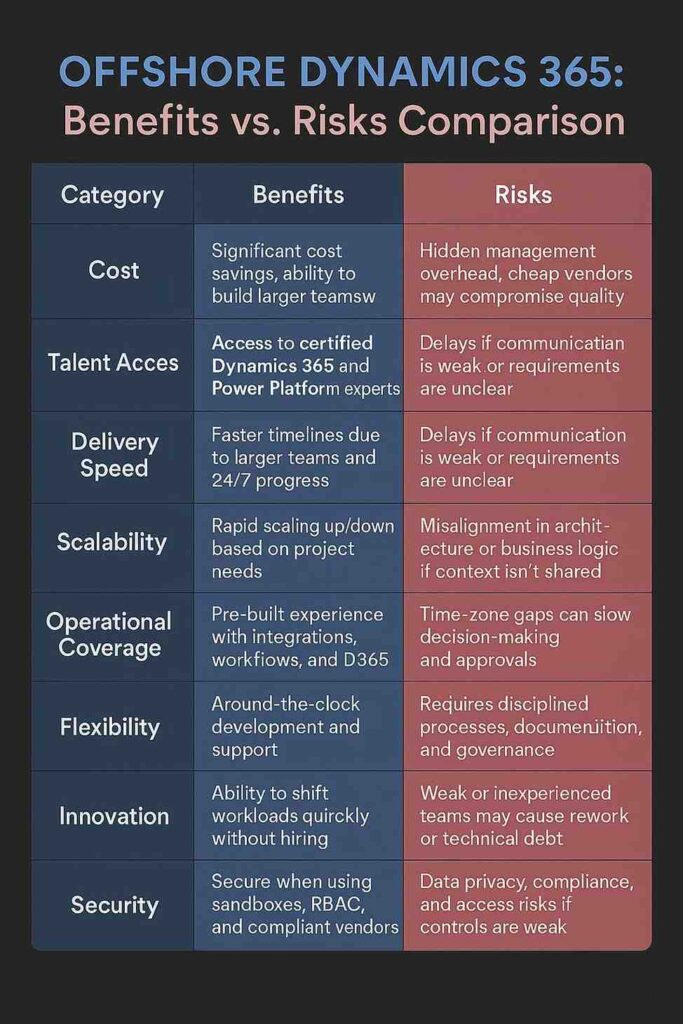
Significant cost savings without reducing capability
Offshore development remains one of the most effective ways to stretch a Dynamics 365 budget. Companies typically see substantial savings compared to local development, allowing them to reallocate resources toward strategic initiatives like AI-driven automation or customer experience improvements. The key advantage isn’t simply “cheaper labor” it’s the ability to build larger, more capable teams without increasing total spend.
Faster project delivery through larger talent pools
When deadlines are tight, delivery speed becomes as important as cost. Offshore teams help organizations accelerate timelines by assembling larger development groups, running parallel workstreams, and maintaining continuous progress around the clock. This is especially useful during implementation sprints, regression testing, or data migration cycles where time pressure is highest.
Access to certified Dynamics 365 and Power Platform experts
Leading offshore partners invest heavily in specialized Microsoft talent. Teams often include certified developers, functional consultants, integration specialists, and Power Platform experts who bring experience across industries. For companies that lack deep in-house Dynamics knowledge, this provides immediate access to skills they would otherwise need months to hire and train locally.
Around-the-clock development cycles and support
One of the biggest operational advantages of offshore models is the ability to maintain a near 24/7 delivery rhythm. While onshore teams close for the day, offshore developers continue progressing on tasks. This shortens development cycles, speeds up testing, and reduces downtime. For support operations, offshore teams can cover after-hours incidents without requiring expensive local on-call rotations.
Flexibility to scale teams up or down on demand
Dynamics 365 programs rarely follow a smooth workload pattern. Some phases require dozens of developers; others only need a handful. Offshore teams make it possible to scale capacity quickly based on workload without long-term commitments. This elasticity gives companies the freedom to start fast, adapt to project changes, and avoid the cost of hiring full-time staff for short-term needs.
Risks Companies Must Consider Before Offshoring
Data security, privacy, and compliance vulnerabilities
Dynamics 365 environments often store sensitive customer data, financial records, and operational workflows. When offshore teams access these systems, companies must ensure that data governance, privacy controls, and compliance requirements remain fully intact. Without strict access policies, audit logging, and role-based permissions, organizations risk exposing customer information or breaching regulations like GDPR, HIPAA, or CCPA. Security is manageable — but only when approached deliberately.
Communication challenges across cultures and time zones
Offshoring introduces natural friction in communication. Time-zone gaps can delay decision-making, and cultural differences may lead to misunderstandings in requirements or design expectations. While many offshore teams follow strong communication protocols, the burden falls on the client to establish structured handoffs, documentation standards, and clear rhythms. When these are missing, communication delays quickly translate into delivery delays.
Quality concerns and higher management overhead
Lower cost does not automatically mean lower quality, but it does require more oversight. Offshore delivery often introduces extra layers of coordination: more check-ins, more documentation, and more QA reviews. Organizations that underestimate this management overhead may face rework, misaligned development, or inconsistent coding standards. Strong processes solve this but they must be established early.
Misalignment in design, requirements, or architecture decisions
Dynamics 365 projects depend heavily on business context: sales processes, customer service workflows, field operations logic, and integration patterns. When offshore teams are not fully embedded in this context, they may make assumptions that lead to rework later. The risk is highest during early design phases, data modeling, and solution architecture. That’s why many companies keep these tasks onshore while delegating development and testing offshore.
Risk of dependency on a single offshore vendor
Over-reliance on one offshore partner can create long-term vulnerability. If the vendor changes pricing, loses key talent, or fails to deliver, the client may struggle to transition quickly. A mature offshore strategy includes vendor evaluation, documented code standards, shared knowledge repositories, and the ability to transition work between teams when necessary.
How to Reduce Risks and Build a Successful Offshore Model
Define a clear delivery model (offshore, nearshore, or hybrid)
Not every project needs the same level of proximity. Some teams benefit from pure offshore delivery, especially when the work is well-defined and repeatable. Others prefer nearshore to reduce time-zone gaps. Many organizations choose a hybrid model: onshore architects and analysts paired with offshore developers and QA. Selecting the right mix upfront dramatically reduces friction and sets the entire engagement on a healthier trajectory.
Implement strict governance, SLAs, and accountability structures
The strongest offshore partnerships operate with the same discipline as internal teams. This means documented SLAs, sprint cadences, coding standards, escalation paths, and quality gates. When expectations are explicit not implied teams spend less time re-clarifying and more time delivering. Clear governance also protects you if delivery quality slips, giving you structured leverage to correct issues early.
Establish strong security and role-based access controls
Security should be designed into the engagement, not added as an afterthought. Limit offshore access to sandbox or UAT environments where possible. Use role-based permissions, multifactor authentication, logging, and conditional access policies to control exposure. Maintain architectural oversight onshore so data governance stays aligned with internal policies and regulatory requirements.
Keep high-risk tasks (design, data, approval workflows) onshore
Your onshore team or internal stakeholders should own the pieces that require deep business understanding: solution architecture, process mapping, data modeling, integration design, and final approvals. Offshore teams should focus on delivery: development, configuration, test execution, and documentation. This division creates clarity, reduces rework, and preserves quality where it matters most.
Start with a pilot project before scaling the engagement
A small pilot project reveals more about an offshore team’s capability than any proposal or meeting. Use a 2–4-week test engagement to evaluate communication rhythms, code quality, documentation habits, and speed. If the pilot goes well, scale the model. If not, you’ve minimized risk and avoided locking into a long-term commitment prematurely.
How to Evaluate and Select the Right Offshore Dynamics Partner
Technical vetting and hands-on skills testing
Don’t rely on resumes. Ask for a short technical assignment or live coding session to validate real Dynamics 365 and Power Platform skills.
Certifications, compliance posture, and security maturity
Look for partners with Microsoft certifications, ISO/SOC2 compliance, and documented security practices. This ensures they can safely access your environments.
Delivery processes, QA standards, and communication rhythms
The best offshore teams follow structured sprints, provide clear documentation, and maintain predictable communication patterns. Consistency matters more than speed.
Transparent pricing and realistic timelines
Avoid vendors offering vague pricing or “too good to be true” delivery promises. Clear hourly breakdowns and realistic timelines signal a trustworthy partner.
Proven case studies and long-term client outcomes
Strong partners can demonstrate multi-year relationships, not just one-off projects. Ask for references and sample deliverables to validate quality.
When Offshoring Makes Sense And When It Doesn’t
Ideal scenarios: long-term development and support programs
Offshoring works best when you have ongoing Dynamics 365 needs continuous enhancements, integrations, support tickets, or multi-phase implementations. Stable, repeatable work benefits most from offshore scale and cost efficiency.
Situations where onshore or nearshore is a better choice
If your project requires heavy business discovery, rapid in-person workshops, or constant stakeholder alignment, onshore or nearshore teams may be a better fit. Early design phases often need closer collaboration and faster decision cycles.
Common red flags that offshoring is not the right fit
If requirements are unclear, internal ownership is weak, or your team lacks time to provide feedback, offshore delivery can struggle. Similarly, if the project involves high-stakes data, strict compliance, or sensitive integrations, a hybrid model is usually safer than fully offshore.
Final Thoughts: Getting Offshore Dynamics 365 Right
Why the right structure beats the lowest price
Successful offshoring isn’t about finding the cheapest team. It’s about building a delivery model that protects quality, maintains security, and keeps projects moving. Clear roles, strong governance, and defined responsibilities matter more than hourly rates.
Why blended teams deliver the strongest outcomes
The best results often come from pairing onshore leadership with offshore execution. Onshore teams handle design, data, and business alignment. Offshore teams deliver configuration, development, and testing at scale. This blend balances cost, speed, and control.
A simple framework for deciding your offshore strategy
If your work is repeatable, long-term, and technically defined offshore makes sense.
If your work is ambiguous, high-risk, or requires rapid in-person collaboration keep it closer to home or use a hybrid model.
Make the decision based on outcomes, not assumptions.
FAQs
1. What is offshore Dynamics 365 development?
Offshore Dynamics 365 development means hiring certified Dynamics experts from another country to handle configuration, customization, integrations, and support at a lower cost.
2. Is offshore Dynamics 365 development secure?
Yes, it can be secure when you use role-based access, sandbox environments, MFA, and work with partners who follow ISO or SOC2-level security standards.
3. What are the biggest risks of offshoring Dynamics 365?
The main risks include data security exposure, communication delays, inconsistent quality, and dependency on a single vendor — all manageable with the right structure.
4. How do I choose the right offshore Dynamics 365 partner?
Look for certified professionals, strong case studies, transparent pricing, proven QA processes, and clear communication rhythms. A small pilot project is the best validation step.
5. When should I use offshore vs onshore Dynamics 365 teams?
Use offshore for long-term development and support. Choose onshore or nearshore when you need deep discovery, fast collaboration, or high-risk architecture decisions.